Most of the advice about buying a used car in Laos assumes you're the buyer. Sell one, and you're on the other side of all that caution - which means the questions are different: what paperwork do you actually need, what makes a listing get real responses instead of silence, and how do you not get stuck holding a car nobody wants to close on. Here's what the process actually involves.
The paperwork: simpler than it sounds
Vehicle transfers in Laos are governed by the Land Transport Law (National Assembly Resolution No. 31/NA, 2021), and the requirements are more straightforward than the reputation of "paperwork in Southeast Asia" might suggest. To transfer ownership, you need:
- A certificate of sale.
- Copies of ID (or household census book) for both buyer and seller.
- A warranty certificate from the seller, certified by their village administration.
- The original vehicle registration certificate - the "blue book."
- The vehicle's registration tracking book.
The buyer is responsible for registering the transfer at the Land Vehicle Registry within 30 days, keeping the original license plate. The vehicle also has to pass a roadworthiness inspection as part of the process - structure, steering, brakes, drivetrain, engine, emissions, lights, and seatbelts are all checked. For an interprovincial transfer, the old plate is destroyed and a new one issued once everything checks out, and the registration office is supposed to complete the transfer within 5 business days of inspection.
Registration happens at whichever Department of Public Works and Transport (DPWT) office covers your province, under the central Land Vehicle Registration system run by the Ministry of Public Works and Transport. As the seller, your job is really just steps 1-4 above - the buyer carries it the rest of the way, but it's worth staying reachable until the transfer is actually confirmed, since an incomplete transfer can still come back to you.
One honest caveat: we couldn't pin down the current exact transfer fee or tax percentage from an official source - older references cite roughly 1% of the sale price, but that figure is old enough that we wouldn't treat it as reliable today. Confirm the current fee at your provincial DPWT office rather than budgeting around an outdated number.

Photo: Christophe95 / Wikimedia Commons (CC BY-SA 4.0) - a roundabout in central Vientiane. Getting a car through Laos's registration process is more paperwork than driving, but less than you might expect.
What actually affects your asking price
Toyota dominates the Lao market by a wide margin - the Hilux in particular has consistently been one of the best-selling vehicles in the country, and Toyota's overall market share has historically run well above a third of new sales. If you're selling a Hilux, Revo, Fortuner, or another well-known Toyota model, you're selling into the deepest part of the local demand pool, which generally means faster interest than a less common brand or model.
The 2026 import situation is worth knowing about even if you're not buying: Laos suspended imports of new fossil-fuel and hybrid vehicles from June through the end of 2026, as part of a push toward electric vehicles, alongside an earlier restriction (since August 2024) on new light vehicles priced above $50,000. Neither rule directly changes the rules for selling a used car you already own, but it does shape what's available new right now - worth keeping in mind if a buyer asks why they should consider a used option over waiting for new stock.
Photos and listing basics that actually matter
Laos is a heavily mobile-first, Facebook-first market - the large majority of Lao adults use Facebook, and that's genuinely where most private car sales get discovered, whether through Marketplace, a dedicated buy-and-sell group, or a classifieds site synced to social sharing. A listing that's easy to scan and share on a phone screen will outperform one built for a desktop browser.
A few practical points that make a real difference:
- Shoot in daylight, outdoors, from multiple angles - front three-quarter, rear three-quarter, both sides, interior, odometer, and engine bay. A listing with 6-8 clear photos gets taken far more seriously than one with a single blurry shot.
- Photograph the blue book and registration alongside the car (with sensitive personal details covered) - it signals to a buyer that the paperwork is genuinely in order before they even ask.
- Lead with the honest condition, not just the highlights. Mentioning a known issue upfront costs you less credibility than a buyer discovering it at inspection.
- State the price clearly, and note whether you're open to negotiation or installment arrangements - "cash or installment" is a phrase that shows up constantly in Lao vehicle listings for a reason, since financed private sales are a normal part of how cars change hands here.
Negotiating and getting paid
Bargaining over a stated price is a normal part of buying and selling in Laos generally, not something unique to vehicles - expect an asking price to move somewhat, and price accordingly rather than listing your true minimum upfront.
For payment, cash remains extremely common for private used-car sales, though bank transfer is increasingly used alongside it, and installment arrangements - where the buyer pays over time rather than all at once - are a genuinely normal option here, not a red flag the way they might be treated elsewhere. Whatever you agree to, get it in writing as part of the sale certificate itself, not as a separate verbal understanding.
When it comes to meeting a buyer, the usual common-sense rules apply and are worth repeating anyway: meet in a public, daytime setting where possible, don't hand over the blue book until payment is confirmed, and bring someone with you if you're meeting a stranger for the first time to finalize a deal.
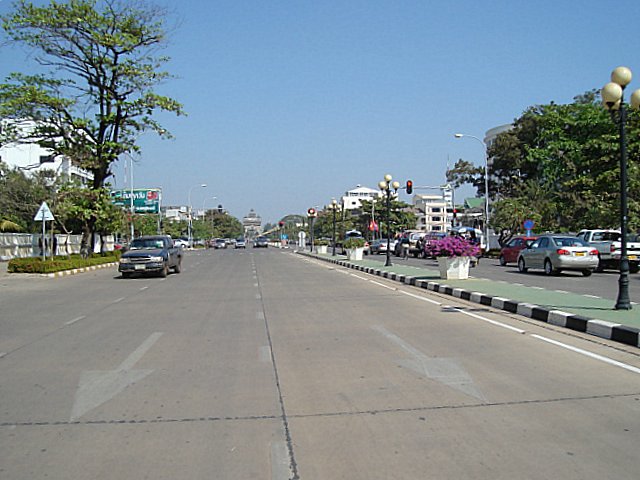
Photo: Wikimedia Commons (public domain) - a main road in Vientiane. Most private car sales here still happen through word of mouth and Facebook rather than a dealership lot.
Where cars actually get sold
The market here runs on a mix of channels: Facebook groups and Marketplace listings for private, peer-to-peer sales; dedicated local classifieds platforms; and formal dealers who take trade-ins and resell. None of these is clearly dominant over the others - a lot of Lao car sales are still genuinely informal, word-of-mouth affairs, which is exactly why a clear, well-photographed listing stands out more here than it might in a more saturated, formal market.
Don't forget the tax side
Vehicles in Laos have historically carried an annual road tax obligation, tracked through a sticker system, with penalties for late payment. We can't confirm the exact current-year requirement with full confidence, so if you're not sure your own vehicle's tax is current, it's worth checking before you list - an outstanding obligation is the kind of thing that can stall a transfer at the worst possible moment, even if it isn't always clearly spelled out as a hard blocker in the transfer process itself.
The honest bottom line
Selling a car in Laos isn't complicated once you know the shape of it: gather the sale certificate, IDs, blue book, and registration tracking book; expect the buyer to handle the formal transfer within 30 days; and put real effort into photos and an honest description, since that's genuinely what separates a listing that sells in days from one that sits for weeks. Toyota models will generally move fastest given how deep local demand runs for them, but a clear, complete, well-priced listing for any real vehicle will outperform a lazy one for a more desirable model.
A few common questions
What documents do I need to sell a car in Laos?
A certificate of sale, ID (or household census book) copies for both you and the buyer, a warranty certificate certified by your village administration, the original blue book, and the vehicle's registration tracking book.
Who is responsible for registering the transfer, buyer or seller?
The buyer is responsible for registering the transfer at the Land Vehicle Registry, within 30 days of the sale, and the vehicle needs to pass a roadworthiness inspection as part of that process.
Is it normal to sell a car on installment in Laos?
Yes - cash-or-installment arrangements are common and widely advertised in local vehicle listings, not treated as unusual the way they might be elsewhere.
Does the 2026 vehicle import freeze affect selling a used car?
Not directly - it restricts new fossil-fuel and hybrid vehicle imports through the end of 2026, but doesn't change the process for selling a car you already own. It may simply shift some buyer interest toward the used market while new-vehicle options are limited.
Ready to list your car? Post a vehicle ad on ul.la - it's free, and buyers across Laos are already browsing.