
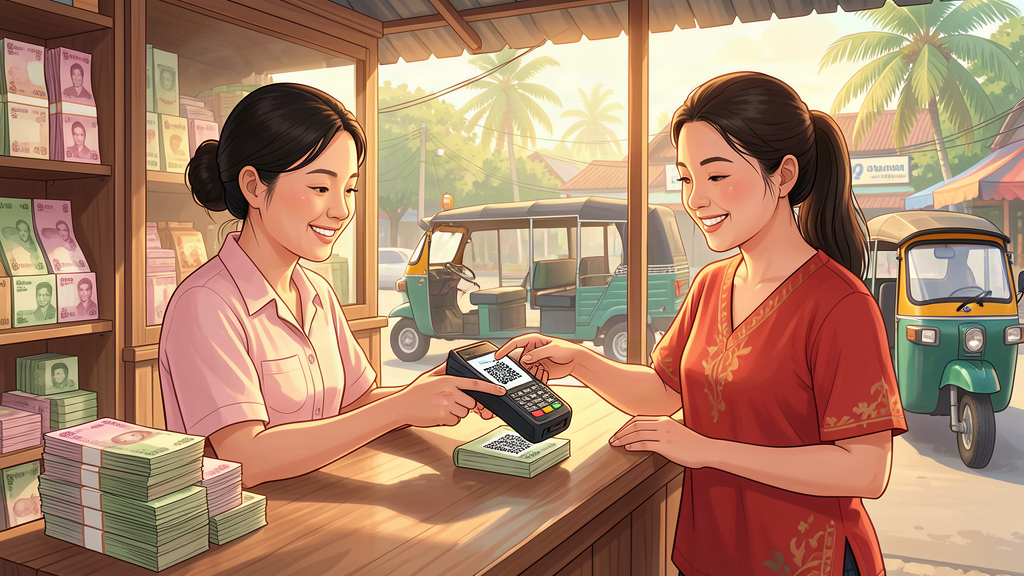
Buying or selling something in Laos is easy to agree on and surprisingly easy to get wrong at the moment of payment. Which currency? Which app? Cash or transfer? This guide covers the practical side, so you know what to do before you meet the other person.
Figures below come from the sources named, read on 16 October 2026. Rates and rules change: check them with your bank before a large payment. This is general information, not legal or financial advice.
A quick reminder: the kip
The Lao kip (LAK) is the national currency. Banknotes are large because the unit is small: on 16 October 2026 BCEL's published rates were 22,272 kip to buy a US dollar from you and 22,618 kip to sell one to you, and 670.07 / 683 kip for a Thai baht (BCEL home page, 16 October 2026).
How we got here, briefly:
- The kip lost value fast in recent years. The IMF reports that the kip depreciated by 47 percent against the dollar in 2022 alone, and AMRO noted in March 2025 that it had lost around half its value over the preceding period.
- 2025 brought a pause. The World Bank's June 2026 Lao Economic Monitor says tighter macroeconomic policies helped stabilise the exchange rate and slow inflation in 2025, and reserves reached a record USD 4.2 billion in March 2026.
- 2026 is stable but fragile. Over the 12 months to mid-October the kip weakened about 3.6 percent against the dollar, and it touched its weakest level on record, about 22,708 per dollar, in July 2026. The World Bank also points to a fuel price shock early this year, with inflation near 10 percent in April. Trading Economics shows Laos inflation at 7.8 percent for September 2026.
What that means for you: the kip is steadier than it was, but it still loses value slowly against the dollar. If you are agreeing a price that will be paid weeks later, settle the currency and the amount in writing.
Which app to pay with
Between two people (bank apps). For paying a private seller, the usual tool is the bank app. You transfer from your account to the seller's account, or scan their QR code. Lao QR lets you scan across banks. The main apps:
- BCEL One (BCEL, the largest bank).
- LDB Trust (Lao Development Bank).
- ACLEDA mobile (ACLEDA Bank Lao).
- Hi App (Phongsavanh Bank): transfers, and payments by scanning a QR code. Phongsavanh's published fee table (read 16 October 2026) lists interbank transfers at LAK 9,000 for amounts below LAK 100,000,000.
- LVB DigiBank (Lao-Viet Bank): its store listing describes free registration and maintenance.
Use the bank where you or the other person already has an account: a transfer inside the same bank is usually the cheapest and fastest. Fees and limits differ by bank and change, so read them in the app.
BCEL's published fee schedule (i-Bank, effective 13 July 2026) is worth knowing:
- Transfers within BCEL: the first LAK 20,000,000 per month are free; above that, fees start at LAK 1,000 to 2,000 per transaction and rise with the amount.
- Transfer to another Lao bank: LAK 12,000 per transaction.
- Personal daily limit: LAK 1,000,000,000.
- Cross-currency transfers (for example kip to dollar or baht) are capped at LAK 4,000,000 a day.
Umoney (Unitel's wallet). Good for small amounts: wallet-to-wallet by phone number, top-up and cash-out at agents, and bank top-ups from several Lao banks. Fees and offers are the operator's own claims; read them in the app.
LOCA PAY, for visitors paying shops. If you are a tourist with no Lao account, LOCA PAY lets you pay a Lao QR code at a shop or restaurant with an international card. LOCA publishes a fee of 3% plus LAK 5,000 per transaction, shown before you confirm. It is designed for paying merchants. It is not a way to pay a private seller for a second-hand car. We expect to see shops and stores listed on UL.la later, and LOCA PAY will be the natural way for visitors to pay them.
Bank transfer or cash?
- Small, same-day, in person (a phone, furniture): cash is fine, or a QR transfer you can see arrive on the seller's phone before you hand over the goods.
- Larger amounts (a motorbike, a car, a deposit): use a bank transfer, ideally at the bank with both people present. You get a record, you avoid carrying a lot of cash, and the transfer reference proves who paid whom.
- Very large amounts: talk to the bank first. Daily limits apply, and cross-currency transfers are capped much lower than kip transfers.
Changing money, and the law on foreign currency
Two things catch people out: the rule on using foreign currency, and getting a fair exchange rate.
The law. Bank of the Lao PDR Decision No. 11/BOL, in force from 3 January 2025, makes the kip the primary currency. Foreign currency may be used as a secondary currency only by authorised entities, and for specific cases such as imported goods and certain businesses (tour agencies, hotels, duty-free shops, exporters and others, some with Bank approval). Otherwise the kip is the only permitted currency. The decision also says foreign exchange must go through authorised commercial banks or foreign exchange markets, and that any exchange rate used for pricing or payment must match the rate the commercial banks announce. Penalties include fines.
Practical reading: for an everyday private sale, expect to be asked to pay in kip, and be careful with anyone insisting on a private exchange rate of their own.
Cash across the border. Under Decision No. 140/BOL (published 10 March 2026), an individual may bring in or take out up to USD 10,000 in cash, or the equivalent, without declaring or seeking approval. Above that, you must declare on entry and get Bank approval to take cash out.
Getting a good rate for baht or dollars.
- The bank is the safest place. Compare the buy and sell rates shown on the bank's own app or website; the gap between them is your cost.
- Every conversion costs you a margin. Avoid converting twice (baht to kip to dollars). If you hold baht and need kip, change once.
- Exchange only what you need. Unused kip is hard to change back outside Laos.
- Read the spread. BCEL's rates on 16 October 2026: USD 22,272 buy / 22,618 sell (a gap of about 1.5%); THB 670.07 buy / 683 sell (about 1.9%). "Buy" is what the bank pays you for your foreign cash; "sell" is what you pay to get it. Cash notes, bills and transfers can carry slightly different rates, and the dollar rate is listed separately for small (1-20) and large (50-100) notes.
- Compare two banks if the amount is large. On 16 October 2026 ACLEDA Bank Lao showed USD 22,511 buy / 22,618 sell and THB 677.20 buy / 683 sell on its website, a little different from BCEL's. Look at the day's rate again before you go: it moves daily.
What about the street (black market) rate? Money changers outside the banking system have long offered their own rates. The World Bank measured an average gap of 12 percent between the parallel-market and official kip/USD rates from January to September 2024, when dollars were scarce at the banks. Since then the gap has closed: the IMF's February 2026 report says the parallel-market premium was largely eliminated in 2025, though it widened slightly after May. The Bank of the Lao PDR also narrowed the band that commercial banks may deviate from the reference rate to plus or minus 1 percent in April 2026. We could not find a current street rate from a reliable published source, so we give no figure. Today the difference may be small, and it can reverse. A better rate is no reason to take the risk: under Decision 11/BOL, foreign exchange should go through authorised banks or exchange markets, and street changers offer no protection against counterfeit notes, short counts or scams. If you choose to use one, you do so at your own risk. UL.la does not recommend it.
Recommendations for any transaction
- Agree the currency in writing before you meet. The ad's currency is the price: a price in baht is not a price in kip. On UL.la, when you filter ads by price range, the filter uses the current exchange rate to show you ads in every currency that falls inside your range, so check the currency shown on each ad before you compare prices.
- See the item first. Never pay before you have seen the goods, however small the amount.
- Use a traceable method for anything beyond pocket money: a bank transfer or a QR payment, not an envelope handed over on the street.
- Confirm the money arrived on the seller's side before you leave with the item, and keep the transfer receipt.
- For a vehicle or land, check the papers first: the registration book or title in the seller's name must match the seller.
- Be wary of urgency. A seller who wants the deposit immediately, or pushes for payment through an unusual channel, is a reason to slow down.
- Meet in a public place and bring someone if the amount is large.
- Keep records: messages, receipts and the ad itself.
Sources read 16 October 2026: BCEL home page and exchange-rate page (bcel.com.la); Trading Economics (12-month and July 2026 trend); World Bank, Lao Economic Monitor, June 2026 and October 2024 (parallel-market gap); IMF 2025 Article IV Consultation (Feb 2026); AMRO (Mar 2025); Tilleke & Gibbins on BOL Decision 11/BOL; VDB Loi on BOL Decision 140/BOL; BCEL i-Bank fee schedule (13 July 2026); ACLEDA Bank Lao website rates; Phongsavanh Bank Hi App fee table; LDB Trust and LVB DigiBank app store listings; Umoney and LOCA published pages.