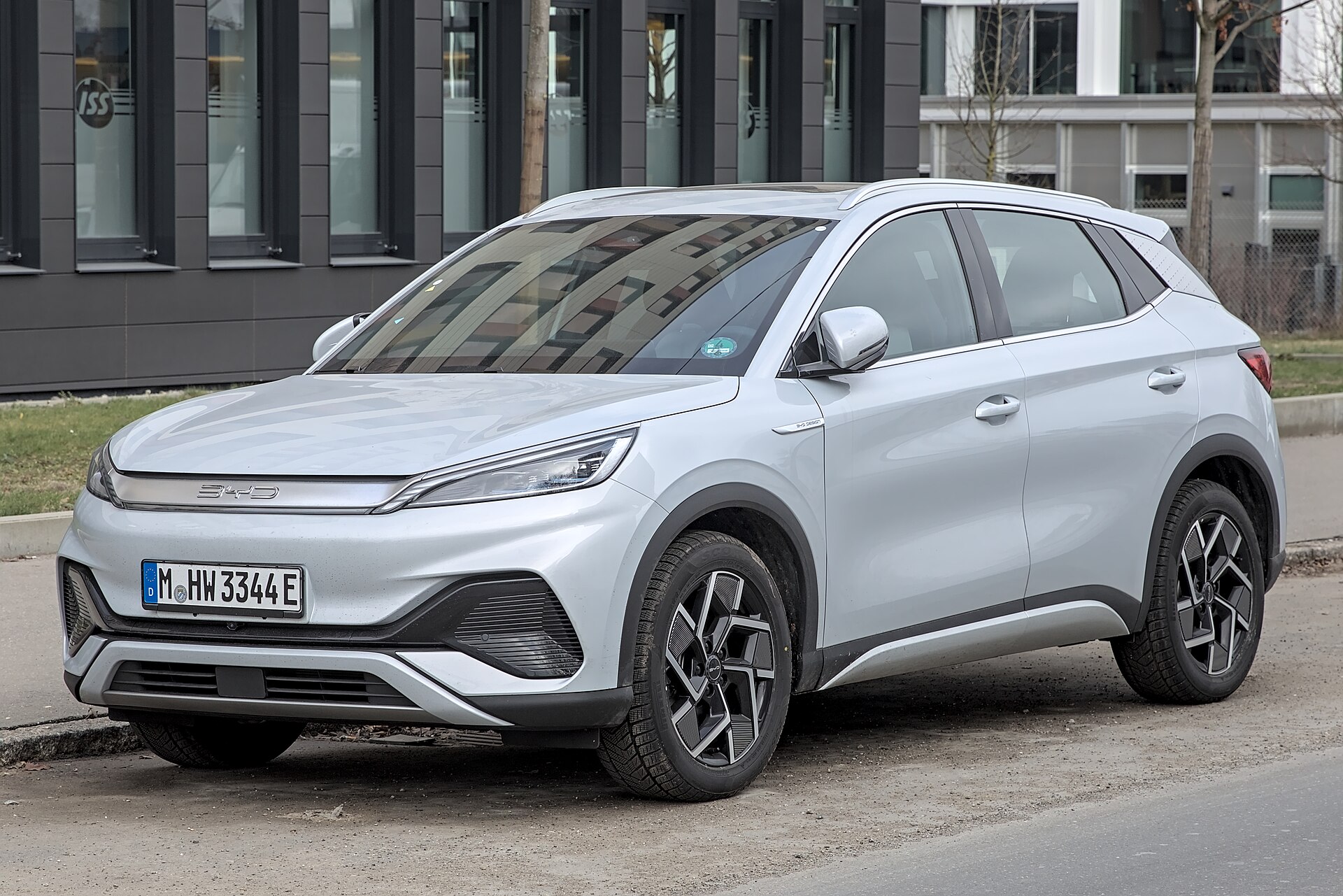
If you'd tried to buy a new gasoline or diesel car in Laos this summer, you'd have had a hard time. Since 1 June 2026, the government has suspended the import of new petrol and diesel passenger cars for the rest of the year, exempting only things like public transport, machinery and project trucks. Within weeks, almost every new car entering the country was electric. That's one of the most aggressive pushes toward electric vehicles anywhere in the world, and it happened in a country where, five years ago, spotting an EV on the road was rare enough that people would turn and look.
So how did Laos get here, what can you actually buy today, and — because this is the part that matters when it's your own money — does an electric car really make financial sense here compared to gasoline or diesel? We dug into the numbers.
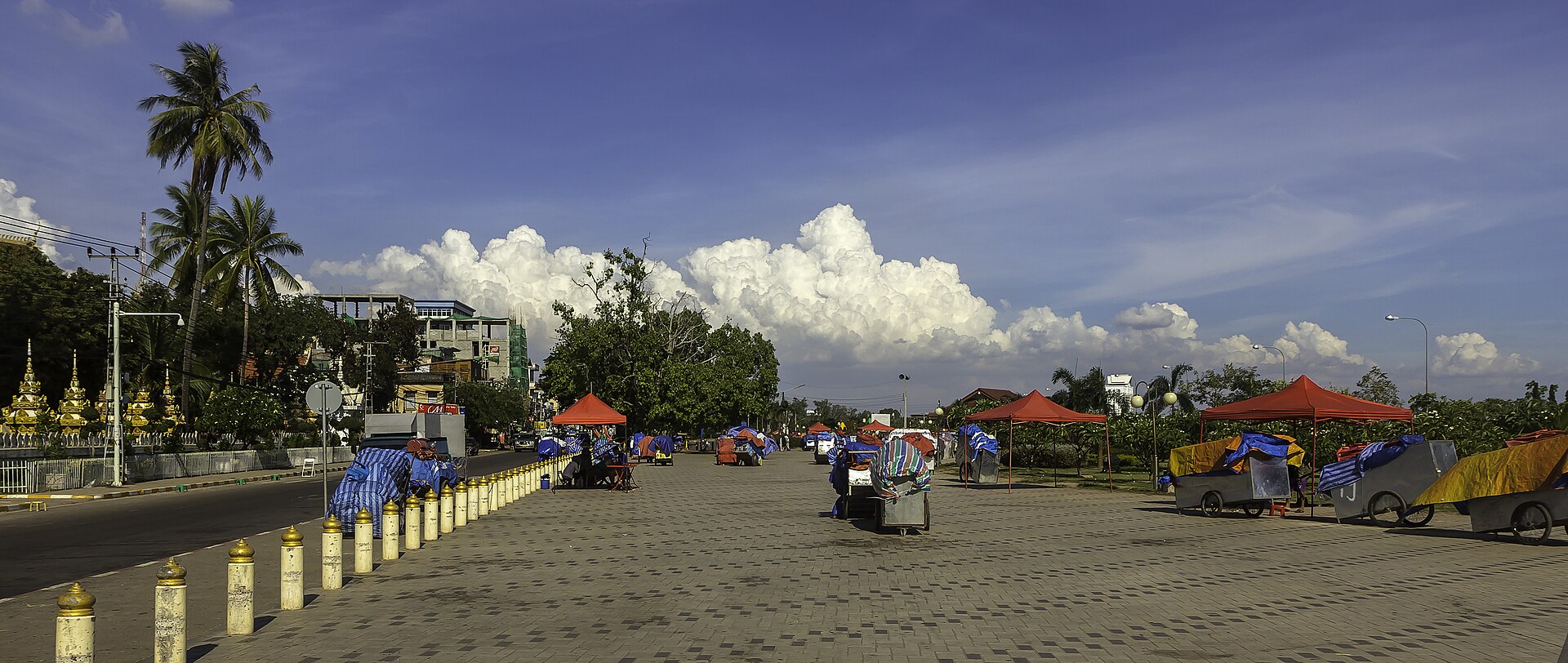
Photo: Stefan Fussan / Wikimedia Commons (CC BY-SA 3.0) — a street in Vientiane, where much of Laos's new EV traffic is concentrated.
How Laos got here: a five-year sprint
Laos has actually been talking about electrification for over a decade. Back in 2013, the government floated a plan to convert 40 percent of the country's motorcycles, tricycles and cars to electric power by 2020. Almost none of that happened — there was no real market, no charging network, and importing an EV was practically unheard of. Even by 2019, when officials met to draft the first proper policy and technical standards for the shift away from combustion engines, the national ambition was modest: just 1 percent of vehicles running electric by 2025.
Then things moved fast. In 2022, Laos removed its import quota on electric vehicles, as long as they met basic international safety and quality standards. EVs jumped from a rounding error to 9 percent of new vehicle imports that year. BYD's Atto 3 arrived that October through local partner MOK Co., Ltd — one of the first mass-market EVs Laotians could actually walk into a showroom and buy. By June 2023, BYD had built out proper local sales and service through Lao Thani and Auto Asia, and the EV share of imports climbed again, to 15 percent. That year, the country sold 4,631 electric vehicles in total: 2,592 cars and 2,039 electric motorbikes.
November 2023 was the moment a lot of ordinary people in Vientiane actually rode in an EV for the first time, even if they weren't shopping for one: Xanh SM, the ride-hailing arm of Vietnam's VinFast, launched Laos's first all-electric taxi fleet with 150 cyan-blue VF 5 Plus cars. It has since expanded to Vang Vieng, Savannakhet and Champasak. By 2024, LOCA — a ride-hailing and charging network operator — had grown its fast-charging network from 20 stations to 40, each capable of a 20–30 minute top-up, backed by a $2.5 million green bond with support from the Asian Development Bank's Frontier Fund and USAID. EV imports for 2024 hit 4,437 units by October alone, already ahead of the full previous year.
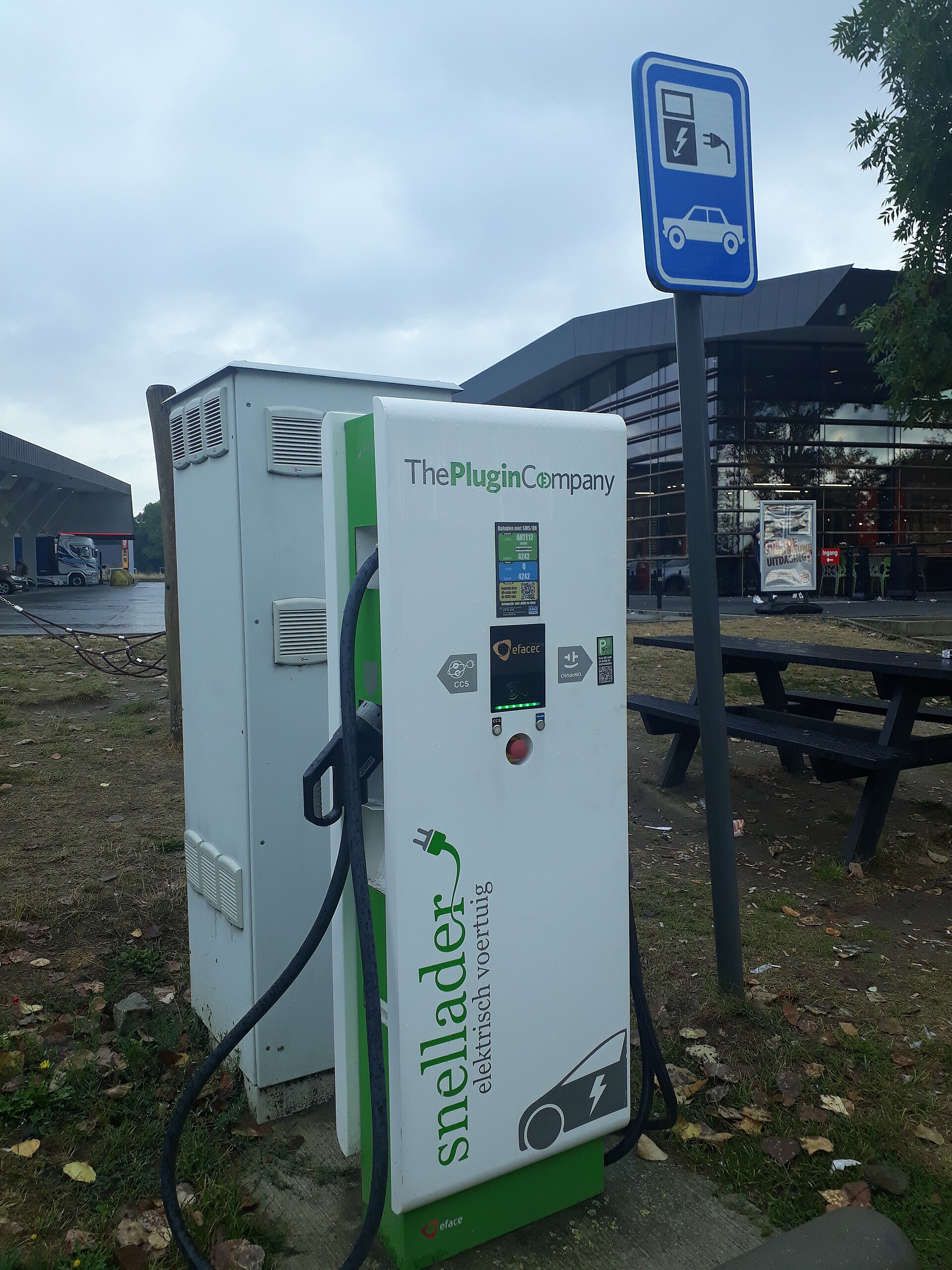
Photo: Aschroet / Wikimedia Commons (CC0) — a public DC fast-charger, the same type of equipment LOCA has been installing across Laos since 2023.
2025 brought more brands into the fold: GSM began officially distributing the VinFast VF 3 and VF 5 for retail sale (not just for taxis), and RMA Lao — an established regional auto distributor — opened a new Vientiane showroom as Kaiyi's official Laos representative.
Then came 2026. In March, the government cut EV registration and service fees by 30 percent while raising equivalent charges on petrol cars by the same amount, and ordered transport companies to run at least 10 percent electric fleets by year-end. In April, Laos signed on with 27 partners to build out charging infrastructure nationwide. And on 1 June, new petrol and diesel passenger car imports were suspended outright through the end of the year. The stated logic, straight from officials: Laos generates almost all its own electricity from hydropower, but imports every drop of the fuel its cars burn. Every EV on the road is money that stays in the country instead of paying for imported diesel and gasoline.
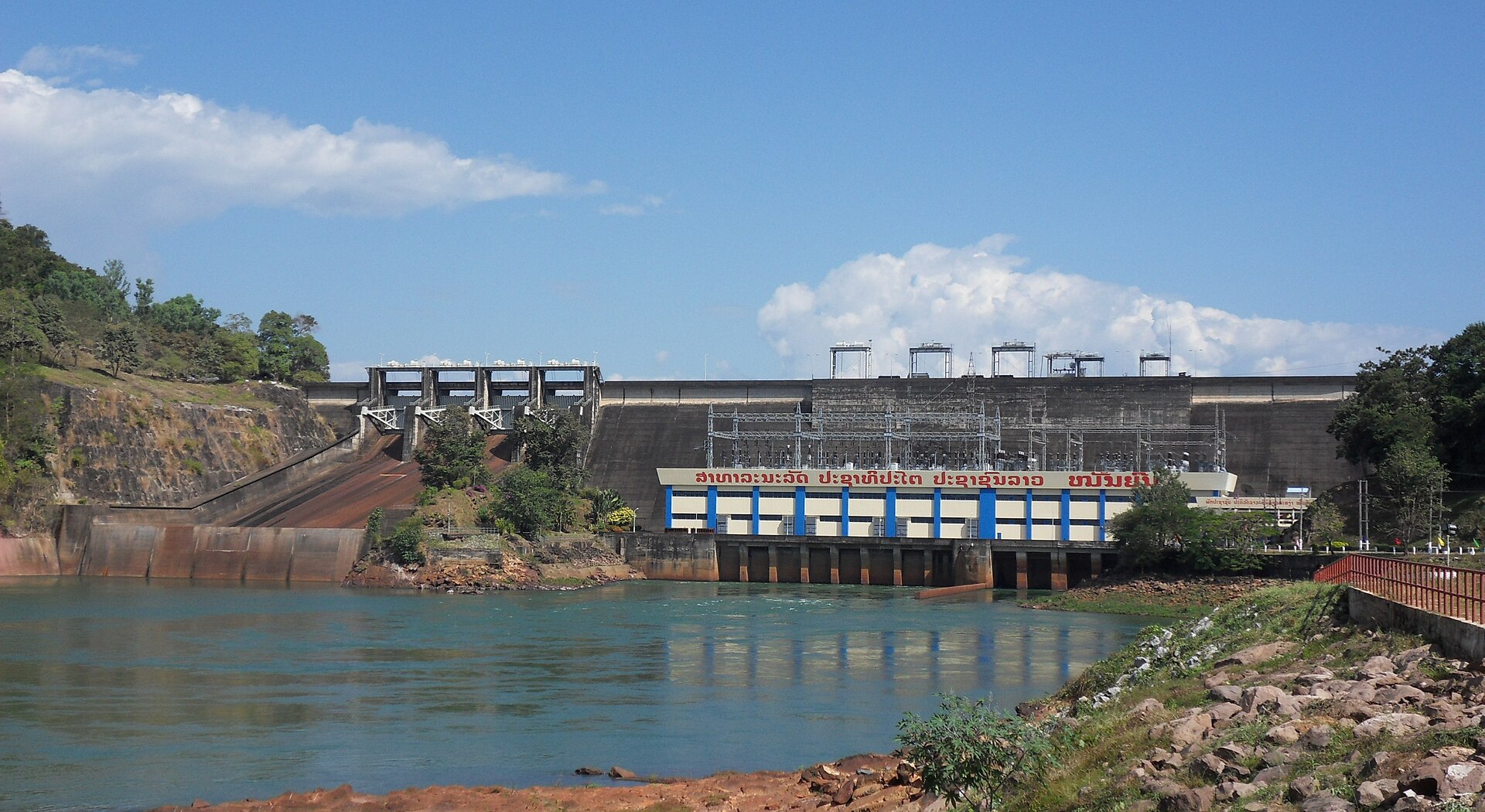
Photo: Chaoborus / Wikimedia Commons (CC BY-SA 3.0) — Nam Ngum Dam, part of the hydropower system that generates most of Laos's electricity.
The national target now is for EVs to make up more than 30 percent of all vehicles on the road by 2030, and LOCA is aiming to have 100 fast-charging stations up by the end of this year. The Lao State Fuel Enterprise, which runs the country's petrol stations, has even signed a memorandum with Electricité du Laos (EDL) to study converting some of its own fuel stations into charging hubs. It's a genuinely rare thing to watch a country's whole car market flip this fast.
What you can actually buy today
The good news is that "buying an EV in Laos" no longer means being a lonely early adopter with nobody around to service your car. Three brands now have real distribution and after-sales networks in the country: BYD (via Lao Thani and Auto Asia), VinFast (via GSM), and Kaiyi (via RMA Lao). Here's how the main models stack up.
| Model | Type | Manufacturer-rated range | Best for |
|---|---|---|---|
| BYD Atto 3 | Compact SUV | Roughly 345–420 km, depending on battery | Families wanting a familiar SUV shape and BYD's proven local service |
| BYD Dolphin | Hatchback | Roughly 340–425 km, depending on battery | Best all-round value for daily city driving |
| VinFast VF 5 | Compact SUV | Around 326 km (NEDC); more like 250–280 km in real driving | Buyers who want the same car already proven by thousands of Xanh SM taxi trips |
| VinFast VF 3 | Mini SUV | Around 210 km | The cheapest way into an EV, for short city hops and errands |
| Kaiyi E5 EV / X3 Pro EV | Compact SUV | Not yet independently verified for the local spec | Buyers willing to try the newest brand on the market, backed by RMA's regional reputation |
BYD Atto 3 is the safe first choice. It's been sold and serviced in Laos since 2022, it looks and drives like a normal compact SUV rather than something experimental, and BYD's local partners have had the longest run to sort out spare parts and technicians. If you want an EV that doesn't feel like a science project, this is probably it.
BYD Dolphin is the one we'd point most first-time EV buyers toward. It's smaller and cheaper than the Atto 3, uses the same reliable LFP "Blade Battery" tech, and its range is genuinely enough for commuting around Vientiane or Luang Prabang with room to spare.
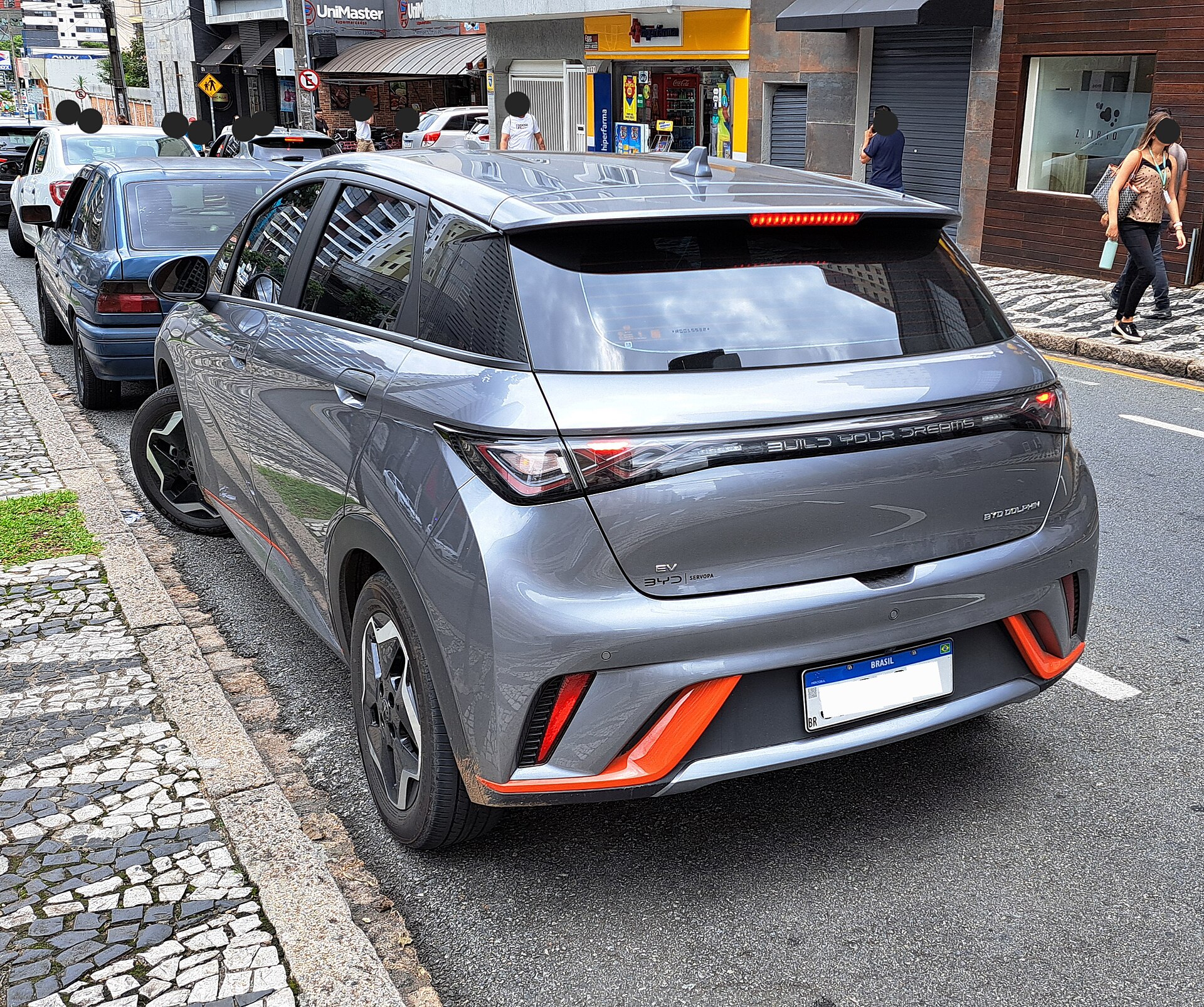
Photo: Mateusmatsuda / Wikimedia Commons (CC BY 4.0) — the BYD Dolphin, one of the best-value EVs now sold in Laos.
VinFast VF 5 has an advantage almost no other new model on this list can claim: thousands of them have already been driven hard, every day, as taxis, since late 2023. That's real-world durability data most brand-new EVs don't get. Since GSM started selling it directly in 2025, buying one privately gets you the same car with a track record.
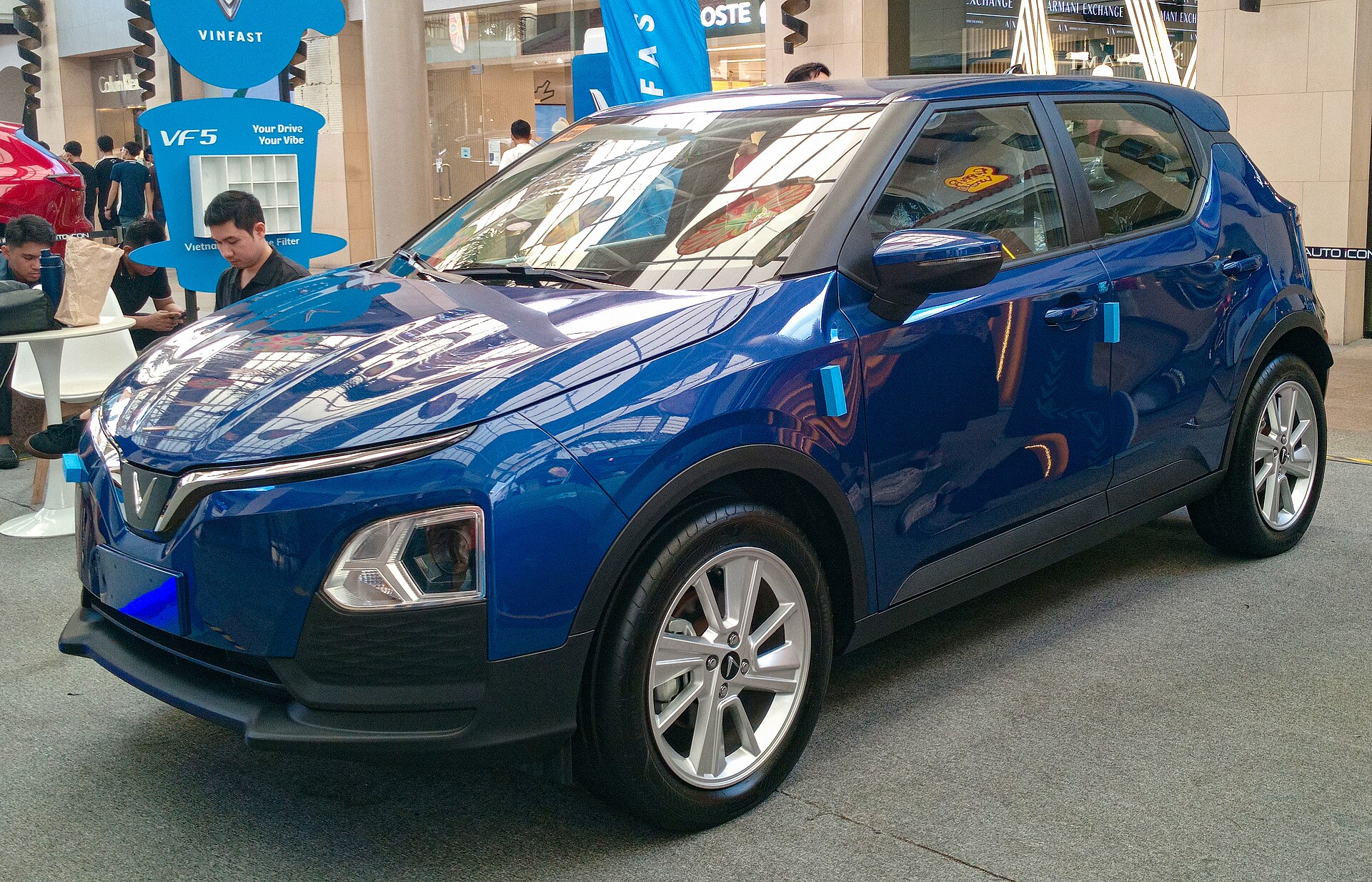
Photo: Ethan Llamas / Wikimedia Commons (CC BY-SA 4.0) — the VinFast VF 5, distributed in Laos by GSM.
VinFast VF 3 is the budget pick. With around 210 km of range, it's not a car for the Vientiane–Luang Prabang run, but for someone who mostly drives within a city and wants the lowest possible entry price into an EV, it does the job.
Kaiyi E5 EV and X3 Pro EV are the newest options, only available since RMA Lao opened its Vientiane showroom. RMA is a serious, established regional distributor (it also represents Ford in several Southeast Asian markets), which gives some confidence on the service side even though Kaiyi itself is a newer name to Lao buyers. Worth a look if you want to compare beyond the two more established brands, but ask the showroom directly for the exact battery and range specs on the units currently in stock — brand-new market entrants change their lineups often.
Pros and cons of an electric car in Laos
The upside
Laos's electricity is overwhelmingly hydropower, generated at home rather than imported. "Fuelling" an EV here keeps money inside the country instead of sending it abroad for diesel and gasoline — which is exactly the argument the government itself makes for the policy.
The tax structure is stacked in the EV's favor, deliberately. Electric vehicles get a 0 percent import tariff and roughly a 3 percent excise tax, against much higher rates for combustion vehicles, plus about 30 percent lower annual road tax. As of March 2026, EV registration and service fees dropped another 30 percent while equivalent petrol car fees rose 30 percent. The gap keeps widening.
The charging network is young but growing with real money behind it — LOCA's build-out is backed by the Asian Development Bank and USAID, and the state fuel company is now studying how to convert its own existing petrol stations into charging hubs. This isn't a side project; it's becoming government infrastructure.
And, bluntly: since June 2026, if you want a genuinely new car in Laos, an EV is close to your only legal option anyway. The "should I go electric" question has quietly turned into "which electric one."
The trade-offs
Charging coverage is still concentrated on major cities and main routes. LOCA's 40-and-growing fast chargers are real progress, but nowhere near the density of the existing fuel station network yet, so a trip into the mountains or a smaller province still needs planning.
Manufacturer range figures are lab numbers. Laos's hills, heat, air-conditioning use and, in places, rough roads will eat into real-world range more than they would on a flat highway test loop — budget for meaningfully less than the sticker figure, especially outside town.
Home charging works best if you have your own parking spot and a stable electrical connection, which isn't a given everywhere outside the two or three biggest cities yet.
Electricity is currently astonishingly cheap here, but it won't stay this cheap forever. Tariff reform already underway is set to raise household electricity rates significantly through 2026–2029 as the government adjusts pricing tiers. It will very likely remain far cheaper than fuel per kilometre — see the math below — but "practically free" is not a permanent feature.
Finally, Laos doesn't build its own EVs any more than it builds its own petrol cars, so new-vehicle prices aren't fully insulated from the same kip depreciation and import-cost pressures that have made fuel prices swing wildly. And because EVs are still new here, the resale market and long-term battery-health data for Laos's hot, humid climate are thinner than in countries that have had electric cars for a decade.
Does the math actually work? EV vs. gasoline and diesel
This is where it gets genuinely compelling. Using prices from Lao State Fuel for Vientiane Capital (20 August 2026) — gasoline 95 at 37,610 kip/litre, diesel at 32,520 kip/litre — against typical Electricité du Laos residential electricity rates in the 900–1,700 kip/kWh range as the tariff reform phases in:
- A small EV like the Dolphin or Atto 3 uses roughly 15 kWh per 100 km in real driving. At a representative mid-tariff of around 1,200 kip/kWh, that's about 18,000 kip (under $1) per 100 km — roughly 180 kip per kilometre. Even at the higher tariffs expected later this decade, that only rises to around 255 kip/km.
- A typical gasoline car burning 7.5 litres per 100 km costs about 282,000 kip per 100 km at current pump prices — roughly 2,820 kip per kilometre.
- A diesel pickup at 8.5 litres per 100 km runs close behind, at roughly 2,760 kip per kilometre.
That's a 10-to-15-times difference in running cost, per kilometre, today — and it holds up even after accounting for the electricity price increases already planned. Put another way: someone driving a modest 15,000 km a year would spend somewhere around 42 million kip (roughly $1,900) a year on gasoline, versus perhaps 3–4 million kip (about $130–180) charging an EV at home. That's a genuine annual saving in the range of 38–40 million kip, before even counting the lower road tax, registration fees and excise tax an EV also gets.
The one place the comparison gets murkier is upfront price, where EVs have historically carried a premium over equivalent combustion cars. But that premium has been shrinking fast as Chinese brands compete hard on price across the region, and since June 2026 there usually isn't a comparable new gasoline or diesel car to shop against in Laos anyway — the real remaining choice for most buyers is a new EV versus a used combustion car, not a like-for-like new one. On pure running costs, the math isn't close: electricity wins by an order of magnitude, and any price premium on the sticker gets paid back in a couple of years of normal driving.
So, should you buy an electric car in Laos right now?
Laos went from "EVs are a curiosity" to "new combustion car imports are suspended" in about five years — one of the fastest transitions of its kind anywhere. If you're buying a new car here today, you're very likely buying electric whether you originally planned to or not, and the economics genuinely back that up for everyday driving in and around Vientiane, Luang Prabang and the other cities where charging is available.
The honest caveat is that charging infrastructure, service networks and the resale market are still catching up outside the main routes, so if you're based in a more remote province, it's worth asking your dealer specifically about charging options near you before you sign anything. That gap is closing quickly, though, with real money and government backing behind it — and for daily driving in the places most people actually live, the case for going electric in Laos is about as strong as it gets anywhere in the world right now.
A few common questions
Is it worth buying an electric car in Laos in 2026?
For daily driving in or around the main cities, yes — the running-cost savings alone are large enough to pay back any price premium within a couple of years, before counting the lower taxes and fees EVs also get.
Where can I charge an electric car in Laos?
LOCA operates the country's main fast-charging network, currently around 40 stations concentrated on major routes and cities, expanding toward a target of 100 by the end of 2026. Most owners also charge at home overnight.
Which electric car should I buy first in Laos?
The BYD Dolphin and BYD Atto 3 currently have the longest track record and the most established local service network, through Lao Thani and Auto Asia.
Can I still buy a new gasoline or diesel car in Laos?
New petrol and diesel passenger car imports have been suspended since 1 June 2026, with exemptions for public transport, machinery and certain project vehicles. For most private buyers, new cars available today are electric.
Ready to see what's already for sale? Browse cars for sale on ul.la, including a growing number of electric models.