Walk down almost any street in Vientiane, Luang Prabang, or Pakse and count the vehicles. Most of what you'll see isn't cars - it's motorbikes and scooters, parked three-deep outside every shophouse and weaving through traffic in numbers cars can't match. A pre-feasibility study prepared for the Lao government puts petrol motorcycles at roughly 75 percent of the country's entire registered vehicle fleet, accounting for around 67 percent of all daily trips in the capital. Laos doesn't have a car culture in the way that phrase usually gets used. It has a motorbike culture, and for most people here, that's still the real, practical answer to "how do I get around."
What's changed recently is that "motorbike" no longer automatically means "petrol." A real electric two-wheeler market has built up in Laos over the past few years - not a token handful of imports, but multiple brands, real dealers, workshops, and even a company converting existing petrol bikes to electric. Here's how both sides of that market actually look right now.
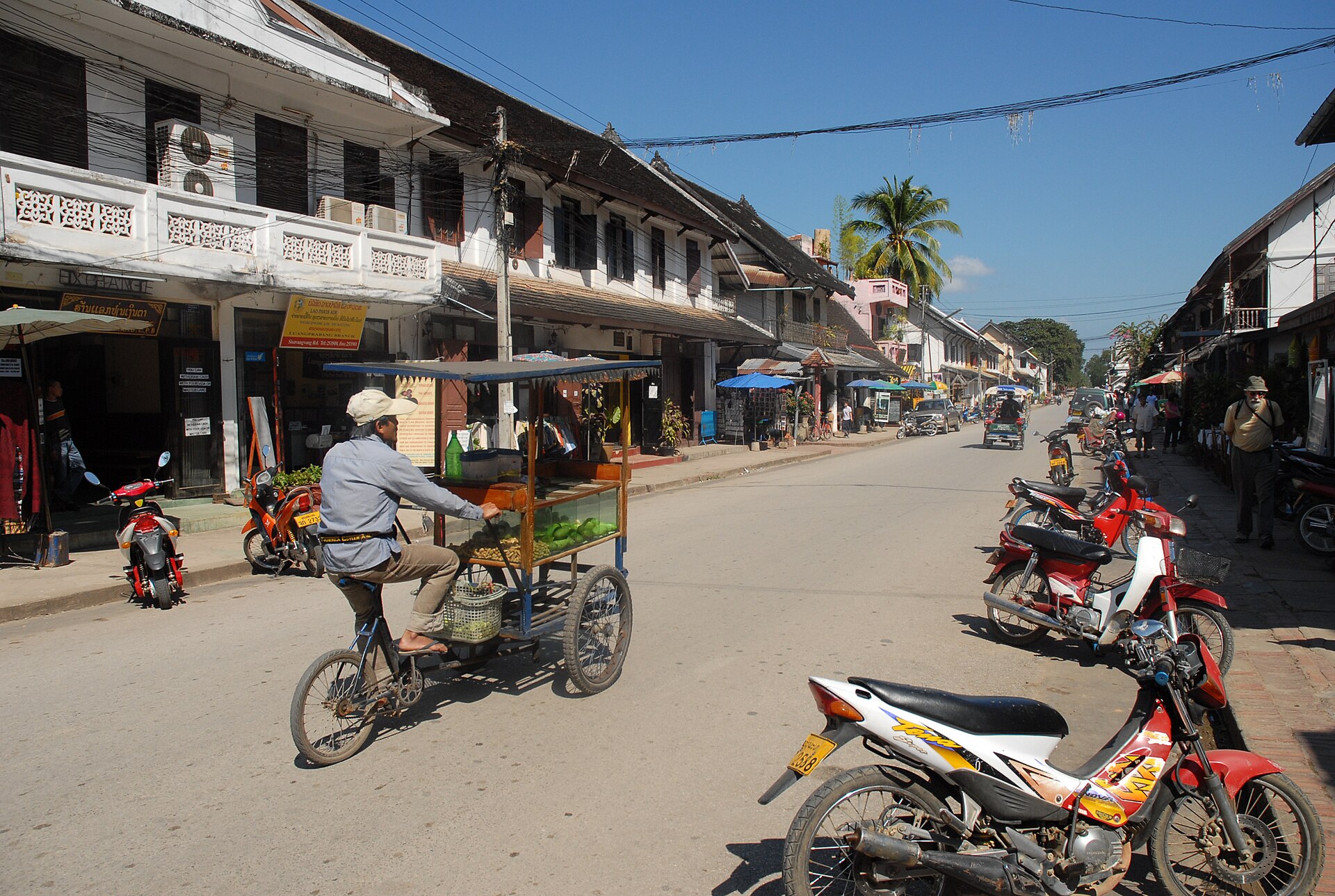
Photo: Alcyon / Wikimedia Commons (CC BY-SA 3.0) - a typical street scene in Luang Prabang. Multiply this by every town in Laos and you get a sense of just how dominant two-wheelers are here.
The petrol market: still the default, still huge
Laos actually assembles a lot of what it rides - the country has more than a dozen motorcycle assembly plants, running Japanese, Korean, and Chinese production lines. That local assembly is a big part of why prices span such a wide range:
| Tier | Brands | Typical price | What you get |
|---|---|---|---|
| Budget | Yincin, YinXieng, Hojin, Zongshen (Chinese) | Around $500 | Cheapest entry point; after-sales support and parts authenticity are the trade-off |
| Mid-range | Kolao (Korean, assembled locally) | $800-$1,000 | Full warranty, professional servicing at dedicated facilities |
| Premium | Honda (Dream, Wave), Suzuki (Smash), Yamaha (Fino) | $2,000-$2,500 | Genuine parts, established service networks, strongest resale value |
Honda's Wave deserves a specific mention: the 100cc version was discontinued almost everywhere else in the world back in 2008, but Laos is one of the few places it's still in production - that's how central this one model is to how the country gets around. If you want the safest, most serviceable choice and don't mind paying for it, a Honda Wave or Yamaha Fino from an authorised dealer is still the default recommendation, precisely because parts and mechanics for them exist in every province.
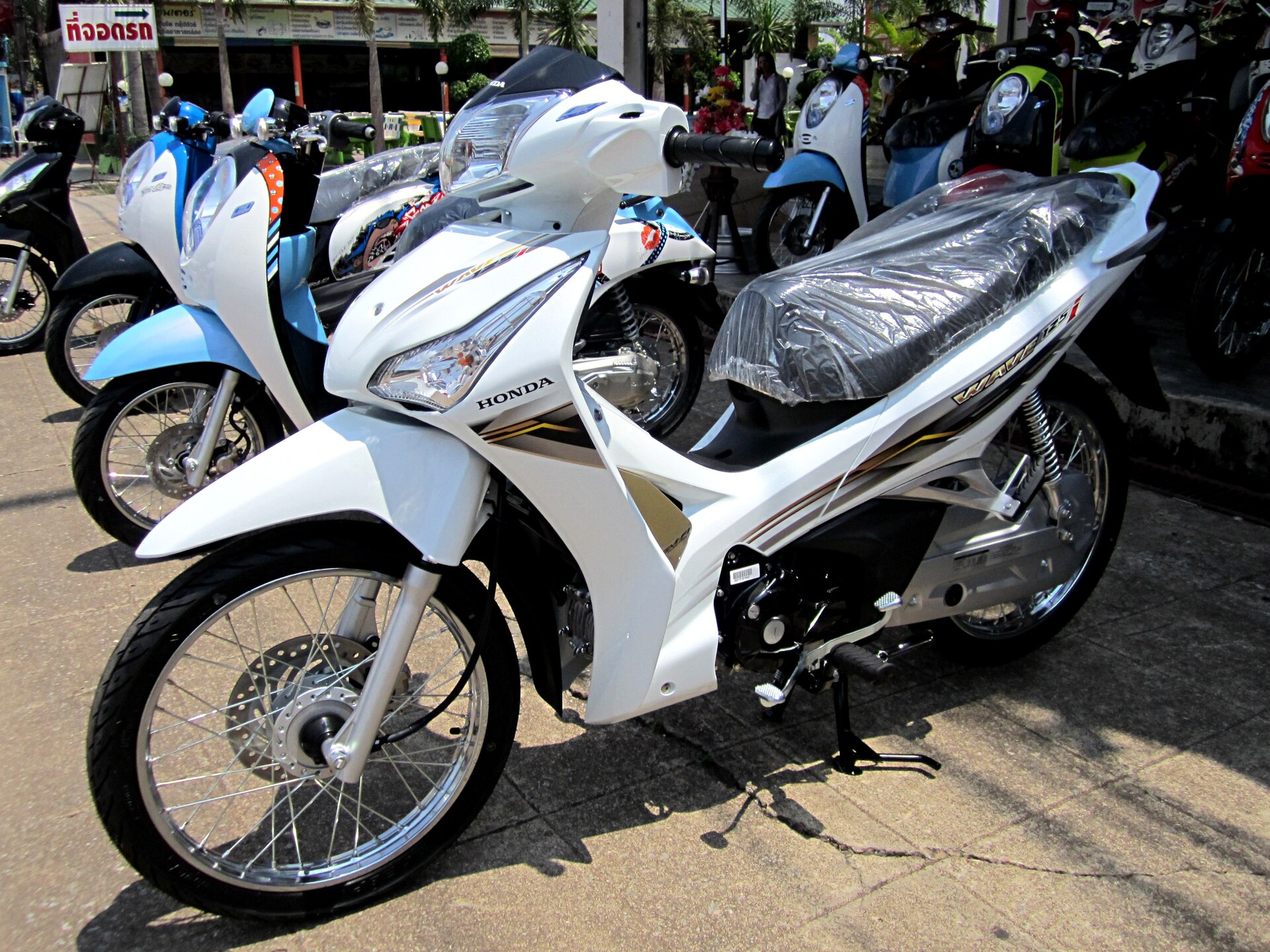
Photo: Khaosaming / Wikimedia Commons (CC BY-SA 3.0) - a Honda Wave 125i. The same Wave family is still manufactured for the Lao market specifically, long after most other countries moved on from the smaller-displacement version.
One legal detail worth knowing: 250cc is the practical ceiling for bikes ridden on Lao roads. Bigger bikes exist here - Laos lifted its old blanket ban on larger-displacement imports back in 2014, moving to an engine-power-based tax instead, largely to stay compliant with WTO rules - but anything above 250cc is a specialist purchase, usually secondhand, not a mainstream option.
The electric market: genuinely real now, not a novelty
This is the part that's changed fastest. A handful of real brands now sell electric motorbikes and scooters in Laos, each with a distinct approach:
- Discover Laos - custom-built bikes with lithium batteries, an in-house workshop with a qualified engineer, and loan bikes available while yours is in for warranty repair. A single 26AH battery gets roughly 70km of range; 32AH stretches to about 80km, and a dual-battery setup pushes that to 140-160km.
- ELS - Samsung battery cells (removable, so you can charge them off the bike) paired with a 3000W Bosch motor, a 65kph top speed, and around 75km of range. It backs that with one of the more serious warranties on the market: two years across the battery, motor, electrical system, and frame.
- Olaa - three models (Milano, Jet, Venezia) built around simpler 1000W motors and lead-acid batteries, roughly 50-70km range at up to 50kph. Less workshop capacity than the others, but a lower price point.
- VinFast - the Vietnamese brand already known in Laos for its electric cars also sells e-scooters here, including the Espero, Feliz, and Klan A2 models, with claimed ranges of 50-90km depending on the battery. Regional pricing runs roughly $1,200-$1,900 depending on battery type.
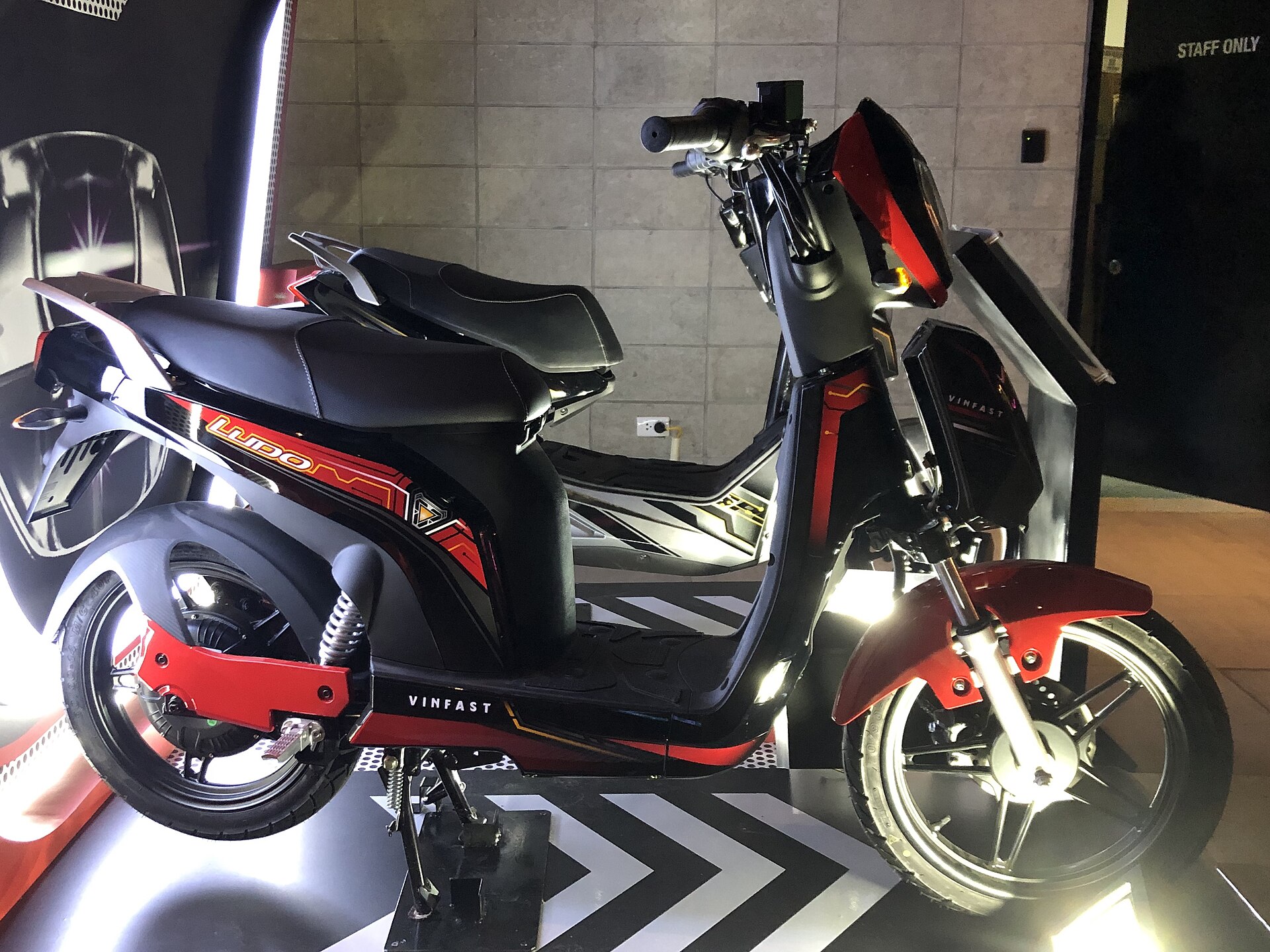
Photo: Newone / Wikimedia Commons (CC BY-SA 4.0) - a VinFast electric scooter. VinFast's two-wheelers, including the Feliz and Espero, are now sold in Laos alongside its better-known electric cars.
If you'd rather not buy outright, evrental.la (a partnership between J&C Concept and Discover Laos) rents both electric cars and motorbikes on 6, 12, and 24-month packages - a reasonable way to try electric before committing. Sunlabob Renewable Energy, a long-established name in Lao renewable energy, also offers simpler e-cycles with 35-70km range.
The most interesting development isn't a bike brand at all. Graphion Energy Solutions, working in partnership with the Lao Ministry of Energy and Mines, has been rolling out a network of fast-charging stations in Vientiane - eight to start, with a 10-minute charge time using lithium-capacitor battery technology, aimed squarely at the roughly 2 million existing petrol motorbikes already on Lao roads. Rather than only selling new electric bikes, Graphion also converts existing petrol motorcycles to electric - which matters a lot in a market where most people's bikes are still perfectly functional petrol ones they're not looking to replace outright.
Petrol or electric: the honest comparison
Upfront cost still favours petrol at the very cheapest end - a $500 Chinese-brand petrol bike beats any electric option on price. But once you're comparing a mid-range petrol bike ($800-1,000) against a lead-acid electric model like an Olaa, the gap narrows a lot, and against a Kolao or entry Japanese bike, some electric options are already competitive.
Running cost heavily favours electric, for the same reason it does for electric cars in Laos: electricity here is generated almost entirely by domestic hydropower and priced accordingly cheaply, while every litre of petrol is imported. Charging an electric scooter costs a small fraction of filling a petrol tank for the same distance, every single time you do it.
Battery type matters more than brand. Lead-acid batteries are cheaper upfront but degrade fast - typically 6-12 months before you're buying a replacement, and budget for that recurring cost every 18-24 months. Lithium batteries cost more initially but last far longer, charge in 2-4 hours instead of 4-10, and usually come with meaningfully better warranties (a year or more, versus six months on many lead-acid setups).
Service network still slightly favours petrol, simply because Honda, Yamaha, and Kolao have decades of dealer and mechanic coverage across every province, while the electric brands are newer and more concentrated around Vientiane. If you're buying electric outside the capital, ask specifically about parts and service access before you commit - it's the one area where electric genuinely still has ground to make up.
One thing that hasn't happened (yet): there's no confirmed ban on new petrol motorbike imports. The petrol/diesel import freeze that hit new passenger cars in June 2026 was written around passenger vehicles specifically - reporting on it doesn't mention motorcycles as either included or exempt, and nothing suggests two-wheelers have been swept into the same restriction. If you want a new petrol bike today, that market hasn't closed the way the car market effectively has. The push toward electric two-wheelers here is happening through incentives, infrastructure, and genuinely improving options - not (so far) through the kind of hard mandate that reshaped the car market overnight.
What to actually check before buying
- For petrol: buy from an authorised dealer if you can afford to, especially for anything beyond the cheapest budget tier - after-sales support is where the budget Chinese brands fall short, not day-one reliability.
- For electric: ask directly about battery chemistry (lithium vs lead-acid), what the actual warranty covers, and where the nearest service point is relative to where you live. Treat manufacturer range claims with real skepticism - real-world range depends heavily on rider weight, speed, and terrain, and the honest advice from people who actually ride these bikes daily is to compare wattage and battery capacity yourself rather than trust a single advertised number.
- Either way: confirm the engine size (or electric equivalent) is within the practical 250cc-class norm for everyday road use, and factor in resale - Japanese petrol brands still hold value best today, though that's likely to shift as the electric brands build a longer track record.
A few common questions
Are electric motorbikes actually a serious option in Laos now, or still early?
Genuinely real. Multiple dealers (Discover Laos, ELS, Olaa, VinFast), a rental option, and dedicated charging/conversion infrastructure from Graphion Energy Solutions all exist today, not as a future promise.
Is the government's petrol/diesel car import ban going to hit motorbikes too?
Nothing confirms that as of this writing. The measure that took effect in June 2026 was written around passenger vehicles, and public reporting doesn't describe motorcycles as covered by it.
What's the single best all-around petrol bike in Laos?
A Honda Wave or Yamaha Fino from an authorised dealer - not the cheapest option, but the one with parts and mechanics available in effectively every province.
Should I buy lithium or lead-acid for an electric bike?
Lithium if you can afford the higher upfront cost - it lasts years rather than months, charges faster, and typically comes with a much better warranty. Lead-acid is a reasonable budget entry point as long as you plan for battery replacement every 18-24 months.
Whether you're after a $500 runaround or the latest electric model, browse motorbikes for sale on ul.la - petrol and electric, new and used.